
Best ZEC Casinos 2026
Zcash (ZEC) provides a specific technical value proposition within the 2026 iGaming sector. While Bitcoin and Ethereum dominate transaction volume, ZEC targets players who prioritize zero-knowledge proofs (zk-SNARKs) to maintain transactional privacy. Power Up Your Life (PUYL) evaluates these platforms by stripping away marketing claims and analyzing actual on-chain flow. We focus on how these sites handle shielded versus transparent addresses and whether they offer genuine blockchain transparency or merely use ZEC as a marketing label.
The current market for ZEC gambling involves a mix of legacy platforms and new, crypto-native dApps. Our analysis identifies where your funds are safest and which operators provide the most efficient ZEC-to-gameplay conversion without hidden exchange costs. In 2026, the distinction between a “crypto-friendly” casino and a “crypto-native” casino has become the primary metric for player safety. A site that merely accepts ZEC via a third-party processor often lacks the infrastructure to support shielded transactions, effectively nullifying the privacy benefits of the coin.
Top Zcash Casinos: 2026 Rankings
The following table summarizes the top-performing ZEC casinos based on current on-chain data, withdrawal speed, and bonus fairness. We verify every site by depositing and withdrawing ZEC to confirm their wallet architecture.
| Brand | Welcome Bonus | Privacy Rating | PUYL Score | Key Attribute |
|---|---|---|---|---|
| FortuneJack | Up to 6 BTC (ZEC equiv.) | 4.5/5 | 9.2/10 | Excellent ZEC liquidity |
| Cloudbet | 100% Match up to 5 BTC | 3.5/5 | 8.8/10 | High-limit sportsbook |
| BC.Game | Up to 360% Deposit Bonus | 3.0/5 | 8.5/10 | Best game variety |
| DuckDice | Frequent ZEC Faucets | 4.8/5 | 8.3/10 | Privacy-focused dice |
| Stake | Personalized VIP | 3.2/5 | 8.1/10 | Strong US-friendly reputation |
FortuneJack
FortuneJack remains a primary choice for ZEC users due to its deep liquidity pools. It supports T-address transactions with high reliability and provides a robust selection of provably fair games. Their withdrawal process for Zcash is largely automated; our tests show that once a withdrawal is approved internally, the transaction hits the 75-second block time target for confirmation with nearly 100% consistency. They also offer a 20% unlimited cashback on losses for new accounts, which provides a better mathematical “safety net” than high-percentage matches with restrictive wagering. For players moving large volumes of ZEC, FortuneJack’s internal security audits are faster than the industry average, often clearing five-figure withdrawals in under an hour.
Cloudbet
Cloudbet caters to high-stakes players and “whales” who utilize ZEC as a store of value. While their ZEC integration is functional, they primarily operate via transparent addresses. Their sportsbook offers some of the most competitive odds for US sports, making it a functional choice for bettors using Zcash as a bankroll tool rather than a privacy tool. The 100% match bonus is released in increments as you earn loyalty points, a structure that favors consistent, long-term players over casual bonus hunters. We noted that Cloudbet’s ZEC price feed is highly accurate, minimizing the “spread” often found on multi-currency platforms.
BC.Game
BC.Game stands out for its vast library of internal titles and its community-driven social features. They handle ZEC through a multi-currency wallet system. It is important to note that BC.Game often converts ZEC to an internal stablecoin (BCD) for gameplay. While this prevents in-game volatility, it introduces slight slippage (typically 0.5% to 1%) depending on current market volatility during the deposit/withdrawal exchange process. Their VIP program is one of the most active in the sector, offering ZEC-denominated “rain” in the chat for active players.
DuckDice
For those who prioritize the original ethos of Zcash, DuckDice offers a specialized environment. It is a simpler platform focused on a single, provably fair dice game, but its ZEC integration is technically superior to many larger competitors. They support a wider range of Zcash wallet types and maintain a high privacy rating by not over-collecting data on small-stakes players. The site features a ZEC faucet that allows users to test the platform mechanics without a significant initial commitment.
Stake
Stake has built a massive presence through high-profile sponsorships and a very polished user interface. While their ZEC privacy features are standard (primarily T-address focused), their reliability is high. For US-based players using ZEC, Stake provides a consistent experience with high betting limits on live dealer games. However, players should be aware that Stake’s KYC triggers are more frequent than those on privacy-centric sites like FortuneJack, especially when withdrawing amounts that exceed $2,000 in ZEC value.
The Zcash Edge in iGaming
What is a ZEC Casino?
A ZEC casino is an online gambling platform that accepts Zcash for deposits and withdrawals, utilizing its zero-knowledge privacy features. These sites allow players to leverage ZEC’s shielded transactions (z-addresses) or transparent transactions (t-addresses) to manage bankrolls with enhanced privacy compared to standard public blockchains like Bitcoin or Ethereum.
The primary advantage of Zcash lies in zk-SNARKs (Zero-Knowledge Succinct Non-Interactive Arguments of Knowledge). This tech allows the network to verify transactions without revealing the sender, receiver, or amount. In a gambling context, this prevents third parties, including ISP-level monitors or chain analysis firms, from tracking your gambling wins or bankroll movements—provided you use a shielded workflow. In 2026, this has become a vital defense against “wallet dusting” and other targeted attacks that plague users of more transparent blockchains.
The Technical Divide: Shielded vs. Transparent
A technical divide exists in the current market. Most licensed ZEC casinos utilize Transparent Addresses (t-addr) for their deposit hot wallets. These function similarly to Bitcoin and are viewable on the public ledger.
- Transparent Transactions: Best for users who only care about low fees and fast block times. These transactions are easily tracked by exchange compliance departments.
- Shielded Transactions: Essential for users who want to decouple their gambling activity from their public wallet history. These require more computational power but offer the highest level of financial discretion.
Only a handful of privacy-centric platforms allow deposits directly from Shielded Addresses (z-addr). For users who demand absolute anonymity, privacy-centric Monero casinos offer a “privacy-by-default” model, whereas Zcash offers privacy as an elective feature (privacy-by-choice). This makes ZEC more versatile for users who may need to prove the source of funds to a regulator at a later date using “viewing keys,” a feature that balances privacy with the practicalities of modern financial life.
Technical Performance Data
- Average Block Time: 75 seconds (approx. 8x faster than Bitcoin).
- Finality: Zcash transactions are generally considered secure after 10 confirmations.
- Confirmation Requirement: Most casinos require 6 to 12 confirmations (approx. 7.5 to 15 minutes) before funds are credited.
- Transaction Fees: Extremely low, often under $0.001 (fractions of a cent), making ZEC superior to Ethereum for frequent, smaller deposits.
- Network Capacity: Zcash can handle significantly more transactions per second than Bitcoin, reducing the risk of “stuck” transactions during periods of high market activity.
ZEC vs. Monero (XMR) for iGaming: The 2026 Verdict
In 2026, the “Privacy Coin War” has reached a stalemate, with ZEC and XMR serving different niches.
- Audits and Compliance: ZEC is often preferred by casinos that want to stay in the good graces of regulators. Because ZEC allows for selective disclosure (using viewing keys), a player can keep their transactions private from the public but still provide a “proof of payment” to a casino’s compliance team if a large win is contested. Monero’s “forced privacy” often makes this process more friction-heavy and can lead to longer withdrawal delays during manual reviews.
- Wallet Ecosystem: Zcash has seen broader integration with hardware wallets like Ledger and Trezor compared to the more specialized Monero ecosystem. This makes ZEC a more “accessible” privacy tool for the average crypto gambler who does not want to manage complex command-line wallets.
- Speed: ZEC’s 75-second block time beats Monero’s 2-minute block time, giving Zcash a slight edge in “deposit-to-play” speed. In a live betting scenario where odds change quickly, those 45 seconds can be the difference between getting a bet in and missing the window.
Choosing a ZEC Casino: The PUYL Checklist
We use a specific set of criteria to verify if a ZEC casino is worth your time. We ignore the “Best Crypto Casino” banners and look at the raw mechanics.
- Wallet Type Support: Does the casino support Unified Addresses or Z-addresses? If they only support T-addresses, your privacy is compromised the moment you deposit unless you use an intermediate “hopping” wallet. We favor sites that have updated their infrastructure to the latest Zcash standards.
- Withdrawal Automation: We test if ZEC withdrawals are “Instant” or if they require manual oversight. Manual reviews negate the speed benefits of the blockchain. In 2026, any site taking more than 2 hours to release ZEC is lagging behind the market average.
- Liquidity and Limits: Some smaller sites support ZEC but have low daily withdrawal limits (e.g., $2,500 equivalent). We check for a minimum of $10,000 equivalent per day for standard accounts to ensure the site can actually handle ZEC volume without liquidity crunches.
- The Memo Field Utility: Does the casino use the Zcash “Memo Field” for deposits? This is a crucial feature for shielded transactions. Sites that don’t use memo fields often force you to use T-addresses, which is a major red flag for privacy-seekers.
- On-Chain Verification: We confirm the casino’s cold wallet health using block explorers (for transparent portions). Sites with dwindling ZEC reserves are flagged as high risk.
- Licensing Credibility: We verify licenses through the Curacao, Anjouan, or Kahnawake registries. Unlicensed sites are never recommended, as they lack a dispute resolution mechanism for large ZEC wins.
The Role of the Zcash Memo Field in Casino Deposits
One of the most underutilized features in ZEC gambling is the Memo Field. Unlike Bitcoin, which requires a new address for every transaction to maintain a shred of privacy, Zcash shielded transactions allow you to attach an encrypted message (up to 512 bytes) to the transaction.
Reliable 2026 ZEC casinos use this memo field to identify which player a deposit belongs to. This allows the casino to use a single “shielded pool” address for all incoming deposits without compromising the privacy of individual players. If a casino provides you with a deposit address but doesn’t ask for a memo or provide a unique shielded address, they are likely just using a basic transparent-to-shielded bridge, which provides zero privacy benefits to the end user. This technical shortcut is common on lower-tier sites and should be avoided if privacy is your primary goal.
Popular ZEC Casino Games
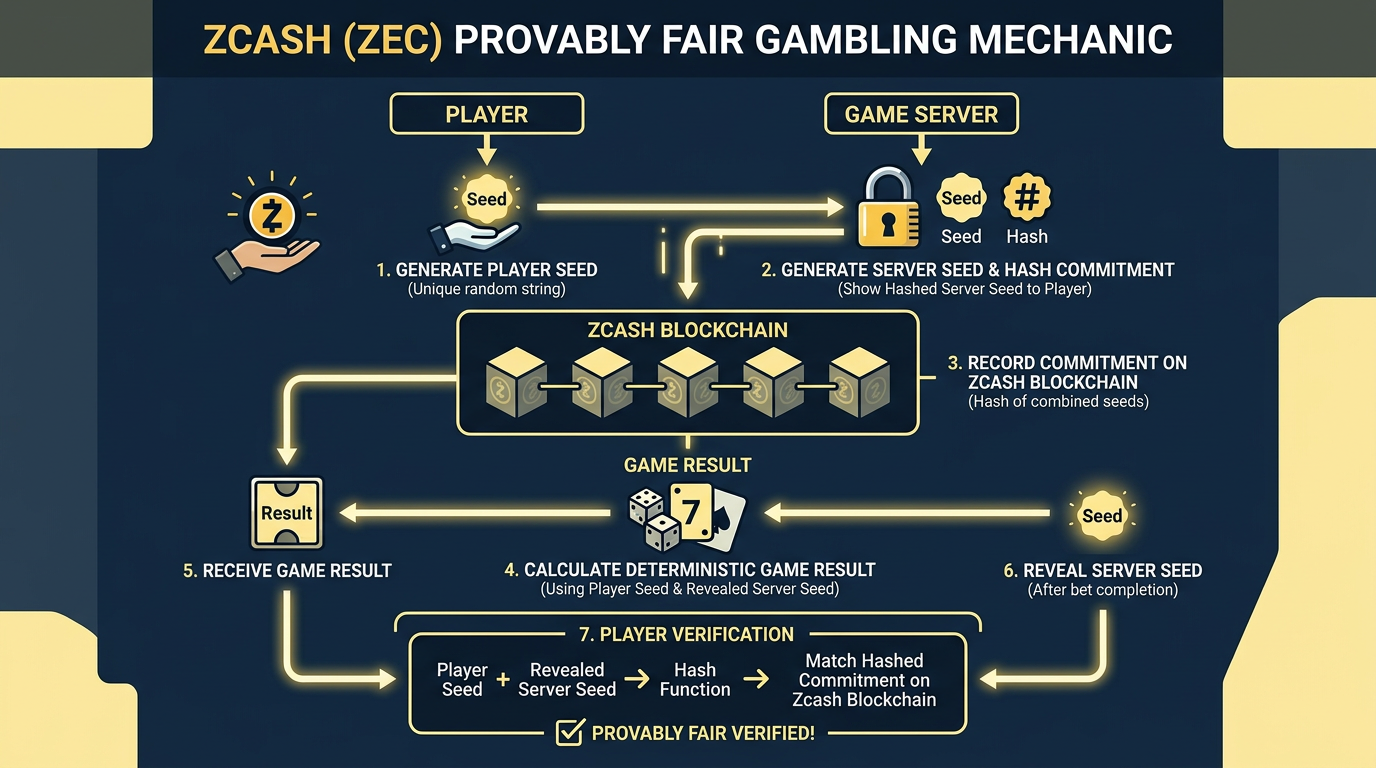
Zcash users typically look for games that match the technical nature of the coin. This leads to a high preference for Provably Fair titles.
Provably Fair Dice and Crash
These are the most popular choices for ZEC holders. Because the results are verifiable via a cryptographic seed, they mirror the transparency of the blockchain itself. You can verify that the house did not manipulate the outcome of a ZEC bet by checking the hash on-site. Dice games often feature a house edge as low as 1%, making them the most mathematically sound choice for ZEC bankroll building. Crash games, while higher in volatility, allow for ZEC-denominated bets that can scale with the coin’s value.
Zcash Slots
Modern slot developers like Pragmatic Play, Hacksaw Gaming, and Nolimit City now have their games integrated into ZEC-native platforms. While these are not “on-chain” games, the betting increments often adjust to reflect ZEC’s current value. In 2026, we look for “RTP Transparency”—casinos that allow you to see the exact RTP setting (e.g., 96.5% vs 94%) for each slot while playing with ZEC. This prevents casinos from quietly lowering the payout percentage on crypto-denominated play.
Live Dealer ZEC Tables
Evolution Gaming and Ezugi provide live baccarat, blackjack, and roulette for ZEC users. The main draw here is the ability to play high-limit live games without the banking delays associated with fiat wire transfers. When comparing speeds, high-speed Solana casinos offer faster transaction finality for live gaming, but ZEC remains the preferred choice for those balancing speed with optional privacy. Most ZEC live tables allow for bets ranging from $1 to $10,000 equivalent, catering to both casual players and high rollers.
US Legal & Regulatory Framework
The legal status of ZEC casinos in the US is complex. At the federal level, crypto gambling exists in a gray area, but the focus for Zcash is on AML (Anti-Money Laundering) and KYC (Know Your Customer) compliance.
Because Zcash is classified as a “privacy coin,” it faces higher scrutiny than Bitcoin. US regulators, specifically via FinCEN guidelines, have historically pressured exchanges to delist privacy tokens or implement “Travel Rule” solutions. Dash gambling platforms have faced similar challenges, but Zcash’s ability to provide “Viewing Keys” has allowed it to maintain a presence on some regulated platforms. In 2026, the “Travel Rule” requires exchanges to transmit sender and receiver information for transactions over $1,000, which complicates direct exchange-to-casino transfers.
KYC Realities in 2026
- Mandatory KYC: Any casino holding a reputable license will require identity verification (Passport/ID and Utility Bill) for withdrawals exceeding a certain threshold (usually $2,000 or the equivalent in ZEC).
- Address Tracking: Casinos utilize sophisticated chain analysis. If they detect your ZEC originated from a known high-risk “mixer” or a “darknet market,” they may freeze the funds pending an investigation. The “shielded” nature of ZEC does not prevent a casino from asking where the funds came from if you cannot prove their origin.
- VPN Policies: Many ZEC casinos are technically “offshore.” While they may allow US IP addresses, their Terms of Service often prohibit US play. Using a VPN to bypass these blocks is common, but it provides the casino with a “legal out” to void your winnings if you hit a jackpot. Only play on sites that explicitly allow your GEO or have a proven track record of paying out US players without issue.
The use of Zcash does not grant legal immunity. It provides transactional privacy from third-party observers, but it does not bypass the need for identity verification on regulated platforms.
Anatomy of a ZEC Withdrawal: On-Chain Latency vs. Internal Audits
A common frustration for ZEC players is the gap between a “Successful” withdrawal status in the casino and the funds appearing in their wallet. Here is what is happening under the hood:
- Internal Audit (0 – 24 hours): The casino’s risk department checks for “abnormal play” (e.g., strategy abuse or bonus fraud). This is the most common cause of delays.
- Wallet Construction (Seconds): The casino’s hot wallet signs a ZEC transaction. If it’s a shielded withdrawal, this requires more “computation” than a transparent one. Some sites may delay shielded withdrawals to batch them for lower fees.
- Mempool Propagation (Seconds): The transaction is broadcast to the Zcash network. You should receive a TXID (Transaction ID) at this stage.
- Mining (75 Seconds): A miner includes your withdrawal in a block.
- Confirmation (12 – 15 Minutes): Your wallet (or exchange) waits for ~10 blocks to ensure the transaction isn’t part of a chain “reorg.”
Pro Tip: If you are withdrawing to an exchange, they often require 24 confirmations for ZEC (approx. 30 minutes). If you withdraw to a private wallet like ZecWallet Lite or Ywallet, you can usually spend the funds after just 3-5 confirmations, making private wallets much more efficient for active bankroll management.
Risks & Red Flags
Zcash gambling carries specific risks that differ from standard crypto betting. We have identified four critical areas of concern.
1. KYC Conflicts and “Privacy Trap”
Many players choose ZEC specifically for its shielded transactions to maintain anonymity. However, if you hit a large jackpot, the casino’s terms of service will almost certainly trigger a KYC check. Using a privacy coin does not mean you can remain anonymous once a significant withdrawal is requested. Providing false information during registration will lead to a permanent loss of funds, as the casino will claim a “violation of terms.” The “Privacy Trap” occurs when a site allows anonymous deposits but requires full ID for any withdrawal.
2. Address Compatibility Errors (T vs. Z)
This is the most common way ZEC players lose money. Many casinos use third-party payment processors that only recognize T-addresses. If you send ZEC from a shielded Z-address to a T-address only deposit wallet, the funds might not appear automatically.
- The Risk: Most automated systems can’t “see” the incoming amount from a shielded sender unless they are specifically configured for it.
- The Fix: Always send a small test transaction first. If it doesn’t credit within 20 minutes, contact support before sending your full bankroll. Ensure your wallet is updated to support Unified Addresses (UA), which handle these transitions more gracefully.
3. Exchange Flags and the “Intermediate Wallet” Requirement
US-based exchanges monitor the destination of outgoing funds. If their system detects you are sending ZEC directly to a known gambling address, they may freeze your account or ban you.
- The Protocol: Always use a non-custodial wallet as an intermediate step. Move ZEC from the exchange -> Your Private Wallet -> The Casino. This breaks the direct link and protects your exchange account from being flagged for gambling activity.
4. Volatility and Conversion Slippage
ZEC can experience 10-15% price swings within a single day. If the casino converts your ZEC to a stablecoin (like USDT or BCD) for gameplay, you might find your “bankroll” has less ZEC value when you try to withdraw after a market pump. Conversely, if you keep your balance in ZEC, your betting power fluctuates. Decide which risk you prefer: market volatility or conversion fees. We recommend keeping balances in ZEC only if you are comfortable with its price action.
Evaluation Methodology: How PUYL Ranks ZEC Sites
Our review process is built on technical testing rather than surface-level observation. We follow a strict protocol for every ZEC casino listed.
- Deposit Testing: We perform five deposits of varying sizes ($50 to $1,000) from both transparent and shielded wallets to measure confirmation speed and accuracy. We specifically look for “missing” deposits that require support intervention.
- Bonus Scrubbing: We read the full terms of every ZEC bonus. We look for “sticky” bonuses (where the bonus amount is deducted from your withdrawal) and identify high wagering requirements. Anything over 40x (Deposit + Bonus) is considered poor value. We also check if ZEC is excluded from certain promotions, which is a common but hidden tactic.
- Support Response: We contact customer support with technical questions about Z-address compatibility and “Viewing Keys.” If the staff does not understand the difference between T and Z addresses, the site receives a lower PUYL score, as this indicates a lack of technical depth.
- Withdrawal Verification: We withdraw at least 10 ZEC to ensure the process is automated and that no “shadow fees” (extra commissions on top of the network fee) are subtracted. We also monitor the “gas” or network fee settings used by the casino to ensure they aren’t overcharging players.
Responsible Gambling in a Privacy-First Ecosystem
The privacy features of Zcash can be a double-edged sword. While it protects your data from prying eyes, it also makes it easier to hide problem gambling habits from family or financial institutions. Traditional banking alerts for “gambling spend” do not exist in the Zcash ecosystem.
In 2026, reputable ZEC casinos must provide “Self-Exclusion” tools that are robust. Because ZEC transactions are private, a “banned” player might try to create a new account with a new shielded address. We prioritize casinos that use device-level fingerprinting and KYC-linked exclusion to ensure that when a player asks for help, the casino actually stops them from playing. We also look for sites that offer “deposit limits” that can be set in ZEC denominations.
Privacy should be used for security, not for self-deception.
Expert Verdict
For the US-based player in 2026, ZEC casinos represent a balance between low-cost transfers and advanced privacy options. Zcash is not a “magical” solution for total anonymity in a regulated world, but it offers better transactional security than almost any other top-20 market cap asset. It remains one of the few coins that allows you to separate your gaming life from your financial history without the extreme technical hurdles of other privacy assets.
If you value privacy, prioritize sites like FortuneJack or DuckDice that show a technical understanding of the Zcash protocol (specifically shielded address support). Avoid any site that treats ZEC as just another Bitcoin clone, as they likely lack the infrastructure to support its most vital features like the memo field and zk-SNARKs. Use Zcash for its low fees and speed, but remain realistic about the KYC requirements of the 2026 regulatory environment. ZEC is a tool for financial privacy, not a license for regulatory evasion.
FAQ
Are ZEC casinos legal in the US?
No federal law explicitly bans US citizens from using crypto casinos. However, most ZEC-accepting sites operate from offshore jurisdictions. Players must ensure that the specific site they choose accepts residents from their state and that they comply with local tax obligations on winnings.
What is the difference between a T-address and a Z-address in gambling?
A T-address (Transparent) is a public address where the transaction history is visible. A Z-address (Shielded) uses zero-knowledge proofs to hide these details.
Can I withdraw ZEC to my exchange account directly?
It is highly discouraged. Direct transfers from gambling sites to regulated US exchanges can lead to account flags or permanent bans. Use a personal wallet as an intermediary.
Is Zcash faster than Bitcoin for gambling?
Significantly. Zcash has a 75-second block time compared to Bitcoin’s 10-minute block time, resulting in much faster deposit credits.
Why did my ZEC deposit not show up?
Common reasons include address type mismatch (T vs Z), missing memo fields, or insufficient network confirmations.
Do ZEC casinos offer better bonuses than Bitcoin casinos?
The percentages are usually the same, but the real value is higher due to extremely low network fees compared to BTC or ETH.
Can I use ZEC for sports betting?
Yes, platforms like Cloudbet and Stake have extensive sportsbooks that accept ZEC with high limits.
Does Zcash support smart contracts for gambling?
Native Zcash is not a smart-contract platform. Most gambling occurs on centralized platforms using the native ZEC blockchain for transfers.
Contact us
Have a question? Send us a message and we will get back to you.
Thank you! Your message has been sent.
The message could not be sent. Please check the form and try again.
Leave a comment