

Best Pepe Casinos 2026: Top PEPE Coin Gambling Sites Reviewed

A Pepe casino is an iGaming platform where users deposit, wager, and withdraw funds using the PEPE token (ERC-20) on the Ethereum blockchain. These sites provide blockchain-verified games and high transaction transparency, catering to players who prioritize memecoin utility and decentralized asset management within a secure digital environment.
While Bitcoin remains the standard for many, the 2026 market shows a significant shift toward high-liquidity altcoins. PEPE has moved beyond its origins as a social media asset to become a functional tool for online wagering. At PUYL, our analysis focuses on the movement of funds on-chain, ensuring that a platform does not just display a PEPE logo but actually manages the token through secure, verifiable smart contracts. We evaluate these sites based on real-world transaction speeds, gas fee efficiency, and the honesty of their wagering mechanics. In a market where “meme utility” is often a marketing buzzword, we look for casinos that treat PEPE as a tier-one liquidity asset.
Ranked Selection: Top-Rated Pepe Casinos for US Players
The current market for PEPE wagering is divided between global crypto-first platforms and US-specific social models. For players located within the United States, the distinction between a traditional real-money site and a sweepstakes model is the primary factor in determining access and legal safety. In 2026, the complexity of ERC-20 gas fees means that the “best” casino is often the one that optimizes its hot wallet interactions to minimize the cost passed on to the player.
Domestic players must prioritize platforms that understand the regulatory landscape of the US, ensuring that their crypto assets are not subject to sudden freezes due to jurisdictional compliance issues. The following table highlights the top performers based on our 2026 audits.
| Brand | Bonus Type | Min Deposit | Payout Speed | US Access |
|---|---|---|---|---|
| Stake.us | 5% Rakeback | $0 (Daily Credits) | < 2 Hours | Legal (Sweepstakes) |
| BC.Game | 180% Deposit Match | $10 | 5–45 Minutes | VPN Recommended |
| Metaspins | 100% Up to 1 BTC | $5 | Instant On-chain | Restricted |
| Jackbit | Wager-Free Spins | No Min | < 30 Minutes | Restricted |
| Cloudbet | 100% Welcome Bonus | $20 | 15–60 Minutes | Restricted |
Stake.us
Stake.us operates as the primary sweepstakes option for US residents. While it does not always accept direct PEPE deposits for “Gold Coin” purchases, it often integrates Ethereum-based assets through its social gaming framework. The platform provides a compliant way to enjoy slots and table games while maintaining the crypto-centric interface that PEPE users prefer. Its focus on “provably fair” originals—where the house edge is often as low as 1%—makes it a high-trust choice for domestic players. For PEPE holders, Stake.us represents a “safe harbor” where the focus is on gameplay rather than managing the complexities of offshore crypto licensing. The daily login bonuses and social challenges provide a steady stream of play without requiring constant on-chain transactions, which is a major benefit when Ethereum gas fees spike.
BC.Game
This platform is a leader in altcoin support, featuring a dedicated PEPE vault. BC.Game provides a multi-tiered rewards system that is particularly attractive for high-volume players. During our testing, PEPE deposits were credited after 12 network confirmations, typically taking under 10 minutes. The site uses a proprietary currency (BCD) to stabilize wagering, though payouts are processed in the original altcoin. This internal conversion is a double-edged sword: it protects your wagering from PEPE’s 10% hourly swings, but it also means you must trust their internal exchange rate. Compare these features with Dogecoin gambling sites to determine which meme-based asset offers better fee-to-speed ratios for your specific betting style. We also noted that their VIP program offers “Rain” bonuses, which frequently distribute PEPE to active chat participants.
Metaspins
Metaspins is built entirely on Web3 principles, allowing for direct wallet integration through MetaMask or WalletConnect. This removes the need for traditional account registration, making it an excellent choice for players seeking an anonymous environment. Their loyalty program provides up to 57% rakeback, which is calculated based on the actual house edge of the games played with PEPE. We particularly appreciate their “Lotto” feature, which frequently utilizes altcoin prize pools, allowing PEPE holders to enter draws with their native tokens without needing to swap for BTC or ETH first. The interface is optimized for mobile Web3 browsers, ensuring that you can manage your bankroll directly from a mobile wallet without sacrificing security.
Jackbit
Jackbit differentiates itself by focusing on wager-free bonuses. Unlike many competitors that trap PEPE deposits behind 40x wagering requirements, Jackbit often provides incentives that allow players to keep their winnings immediately. This transparency is a core metric in our evaluation of real player value. In the context of a volatile asset like PEPE, a wager-free bonus is significantly more valuable than a massive “sticky” bonus, as it allows you to exit the market quickly if the token price begins to dump. Their sportsbook is equally robust, offering competitive odds on esports, which aligns well with the demographic profile of most PEPE holders.
Cloudbet
As one of the oldest names in the space, Cloudbet offers a structured betting environment. It treats PEPE with the same security protocols as Bitcoin, utilizing cold storage for the majority of its player assets. Their sportsbook is a major draw for PEPE holders looking to hedge their tokens against live athletic events. Cloudbet’s “Marketplace” also allows players to trade loyalty points for real-world rewards, providing a layer of tangible value that many “meme-only” casinos lack. The platform’s stability is its strongest asset; while it may not have the flashy “Web3” feel of Metaspins, its long-standing reputation for honoring high-value withdrawals in the altcoin space is undisputed.
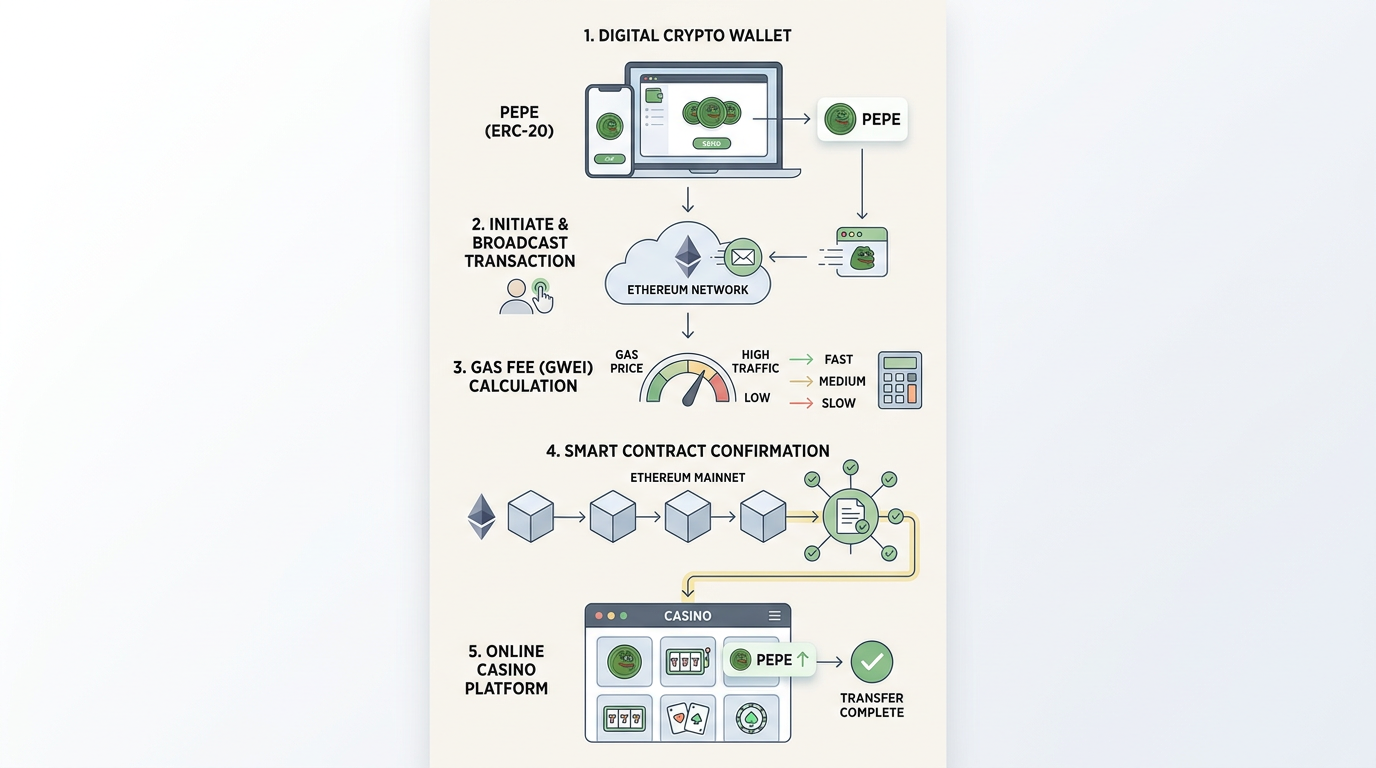
Technical Evaluation: How PEPE Transactions Work on iGaming Platforms
Understanding the technical layer of PEPE is vital for efficient bankroll management. As an ERC-20 token, PEPE operates on the Ethereum blockchain. This means every transaction, whether a deposit to a casino or a withdrawal to a personal wallet, is subject to Ethereum network rules and costs. In 2026, we are seeing more casinos analyze Layer-2 (L2) integrations like Base or Arbitrum for PEPE to reduce these costs, but the majority still rely on Layer-1 (L1) Mainnet.
The Impact of Gwei and Gas Fees
The primary friction point for PEPE users is the gas fee, measured in Gwei. During periods of high network activity—common during meme-asset rallies—the cost to move PEPE can increase significantly. Unlike Ethereum-based casino platforms that may use Layer-2 solutions, many Pepe casinos still require Mainnet transactions for deposits. Players must verify that their intended deposit is large enough to justify the network fee. For example, paying $15 in gas to deposit $50 of PEPE results in an immediate 30% loss of capital before a single bet is placed. We recommend checking a gas tracker before initiating any PEPE transfer to avoid “fee exhaustion.” High-volume players often wait for the weekend or late-night hours (UTC) when gas prices typically dip.
Smart Contract Audits and Transaction Hash Analysis
High-quality Pepe casinos use smart contracts to automate payouts. We look for platforms that provide a public contract address for their hot wallets. This allows players to audit the casino’s liquidity in real-time. If a casino’s public wallet shows a declining balance of PEPE while withdrawal requests are pending, it serves as an immediate flag regarding the site’s solvency. Our 2026 protocol involves analyzing “Transaction Hashes” (TXIDs) on Etherscan to ensure that the casino is actually sending funds from its own reserves rather than relying on incoming player deposits to fund outgoing withdrawals. A transparent casino will have a clear history of high-value outgoing transactions that match their reported payout speeds.
Cold vs. Hot Wallet Security
Security-conscious platforms maintain only a small percentage of PEPE in “hot” wallets (connected to the internet) to facilitate immediate withdrawals. The bulk of player funds should be held in “cold” storage (offline). This architecture protects assets from external hacks. In our testing, the best platforms provided multi-signature (Multi-Sig) approval processes for large PEPE withdrawals. While this may add a 30-minute delay to a $50,000 withdrawal, it is a necessary safeguard for protecting high-value meme-asset holdings. We also look for casinos that utilize hardware security modules (HSMs) to manage their private keys, ensuring that even internal bad actors cannot easily drain the PEPE reserves.
Bonus Structures and Wagering for Pepe Coin
Bonus transparency is where most crypto casinos fail our evaluation. A high percentage match is meaningless if the wagering requirements (WR) are structured to prevent withdrawal. We analyze the “real value” of these offers by looking at how they interact with the volatility of the token.
Sticky vs. Non-Sticky Bonuses: The “Real Value” Calculation
- Non-Sticky: Your deposited PEPE and the bonus funds stay separate. You play with your real funds first and can withdraw at any time if you haven’t touched the bonus money. This is the gold standard for player fairness. It allows you to “forfeit” the bonus if you hit a big win early on, securing your profit without being tied to a rollover.
- Sticky: The deposit and bonus are locked together. You cannot withdraw any funds until the entire wagering requirement is met. We advise extreme caution with sticky bonuses when using PEPE. Because PEPE is a “high-beta” asset (moving more drastically than Bitcoin), a sticky bonus can trap your liquidity during a market crash, preventing you from selling your tokens to cut losses. In 2026, the best sites have moved toward “Parachute” bonuses, which are a variation of non-sticky offers that provide a second chance only after your initial deposit is lost.
The Volatility Factor in Wagering Requirements
If you accept a bonus that requires 40x wagering of a $1,000 PEPE deposit, you must bet $40,000 worth of tokens. If the price of PEPE increases during your play, you reach that goal faster in terms of token count. However, if the price drops, you may find yourself needing to play through significantly more tokens to meet the same USD-denominated requirement. Some sites fix the wagering in the token itself (e.g., wager 1,000,000 PEPE), which provides much better clarity for the player and eliminates “exchange rate risk” during the rollover period.
When reviewing Shiba Inu casino options, we noted that memecoin bonuses often carry shorter expiration dates. Always check if your PEPE bonus expires in 7 days or 30 days. For a volatile asset like PEPE, a 7-day window is incredibly aggressive and often leads to “forced betting,” which increases the likelihood of bankroll depletion. We prioritize sites that offer at least 14 days to clear a standard rollover.
Comparison: PEPE vs. DOGE vs. SHIB for Wagering Efficiency
Choosing PEPE over other meme-assets involves a specific trade-off between liquidity and transaction cost.
| Feature | PEPE (ERC-20) | DOGE (Native) | SHIB (ERC-20) |
|---|---|---|---|
| Network Fee | High (Ethereum) | Very Low | High (Ethereum) |
| Transaction Speed | ~1-5 Minutes | ~1-2 Minutes | ~1-5 Minutes |
| Market Depth | High | Extreme | Moderate |
| Casino Adoption | Growing | Universal | Moderate |
For players, the choice of PEPE is usually driven by “holding intent.” If you already hold PEPE and believe in its 2026 upside, wagering with it directly avoids the tax events and fees associated with swapping to DOGE or LTC. However, from a pure efficiency standpoint, DOGE remains superior for small-stakes players due to the negligible network fees. PEPE is best suited for “Mid-to-High Rollers” who are depositing $500+ at a time, where a $10-20 gas fee represents less than 4% of the total transaction. Furthermore, the “burn” mechanics often associated with SHIB are not present in PEPE, making the latter a more straightforward asset for simple gambling transactions without hidden deflationary costs.
Legal Framework for Pepe Gambling in the US
The US regulatory environment for crypto-based gambling is a patchwork of federal and state rules. Understanding these distinctions is necessary to avoid fund seizure or account termination. In 2026, the focus has shifted toward “Know Your Customer” (KYC) enforcement on exit ramps (exchanges), making the choice of casino even more critical.
Federal Laws and the UIGEA
The Unlawful Internet Gambling Enforcement Act (UIGEA) focuses on the “funding” of illegal gambling accounts. It prohibits US financial institutions from processing payments to unlicensed gambling sites. Because PEPE transactions occur on a decentralized ledger, they do not go through US banks. However, this does not make the act of gambling on unlicensed offshore sites legal at the federal level; it simply places the transaction outside the traditional banking system. If an offshore casino is shut down by US authorities, players have zero legal recourse to recover their PEPE. This is why we emphasize sites with a long-standing history of operational stability.
The Sweepstakes Solution
For residents in states like New York, Florida, or Texas, the safest way to use assets similar to PEPE is through sweepstakes casinos. These platforms do not accept “deposits” for wagering. Instead, they allow you to purchase social tokens, and they often give away “Sweeps Coins” as a bonus. These Sweeps Coins can be used to play games and eventually redeemed for crypto assets, including PEPE. This model is currently compliant with the laws of most US states because it is legally classified as a promotion rather than gambling. It provides a layer of consumer protection that offshore sites cannot match.
State-Specific Restrictions and VPN Risks
Some states, such as Washington and Idaho, have explicit bans on even sweepstakes-style gaming. Furthermore, many offshore PEPE casinos officially ban US players in their Terms of Service (ToS). While many players use VPNs to bypass these blocks, this creates a significant “Withdrawal Risk.” If a casino asks for KYC during a withdrawal and you cannot provide a non-US ID, they may legally seize your PEPE balance for a ToS violation. We only recommend platforms that are either 100% sweepstakes-legal or have a proven track record of “No-KYC” for small-to-mid-tier withdrawals. Always check the “Restricted Jurisdictions” section of a casino’s ToS before sending any funds.
Evaluation Methodology: Our 2026 Testing Protocol
Our reviews are not based on marketing materials. We use a rigorous, data-driven protocol to verify the claims made by Pepe casinos.
- On-Chain Movement Verification: We deposit PEPE from a private hardware wallet and track the transaction on Etherscan. We measure the time from “Broadcast” to “Confirmed” and then to “Credited” in the casino account. We also check if the casino uses an intermediary payment processor, which can add delays.
- Provably Fair Audit: We play a minimum of 500 rounds on “Original” games (Dice, Limbo, Plinko). We use the provided server seeds and client seeds to verify that the outcomes were truly random and not manipulated by the platform. Any platform that does not offer a verification tool or has an “opaque” seed generation process is immediately disqualified.
- Withdrawal Stress Test: We initiate withdrawals during periods of high Ethereum network congestion. This tests whether the casino’s automated system correctly adjusts gas fees (paying enough Gwei) to ensure the transaction doesn’t get “stuck” in the mempool for days. A good casino will prioritize your withdrawal even if it costs them slightly more in gas.
- Liquidity Check: We monitor the casino’s main withdrawal wallets. A platform that moves large amounts of PEPE to exchanges right before a weekend often indicates a liquidity struggle, which we flag in our reports. We prefer sites that maintain steady, high-balance hot wallets.
Risks & Red Flags for PEPE Coin Users
While PEPE offers high liquidity and community support, using it in an iGaming context carries specific risks that players must manage.
The “Rug Pull” and Asset Stability
While the casinos we list are established entities, the PEPE token itself remains a memecoin. Its value is driven more by social sentiment than technical utility. If the token’s value collapses by 90% overnight, your casino balance remains the same in tokens but loses nearly all purchasing power. Expert Tip: Regularly “ladder out” of your PEPE winnings into a stablecoin (like USDC or USDT) to lock in profits, especially after a winning session. This protects your bankroll from the “double loss” scenario where you lose at the tables and the token price drops simultaneously.
Phishing and Wallet Security
Many newer Pepe casinos encourage “Web3 logins” via WalletConnect. While convenient, this is a prime target for phishing. A malicious site may present a “Connect Wallet” button that, once clicked, asks for permissions to “spend” your PEPE. If you grant this permission to a fraudulent site, they can drain your entire wallet balance.
- Rule 1: Never use your primary storage wallet (where your long-term holdings are) for casino connections.
- Rule 2: Use a dedicated “burner” wallet (like a separate MetaMask account) for gambling that only contains the funds you intend to wager.
- Rule 3: Regularly check your wallet permissions on sites like Revoke.cash to ensure no casino still has “infinite” spend approval for your PEPE.
Gas Fee Exhaustion and “Dust” Balances
Players with smaller bankrolls often find that gas fees consume their potential winnings. Furthermore, many ERC-20 casinos have “minimum withdrawal” limits that are higher than the deposit limits. If you deposit $50 and end up with $60, but the minimum withdrawal is $100, your funds are effectively trapped. This is known as creating “Dust.” Always check the withdrawal minimums in PEPE before you send your first deposit. In 2026, some platforms have introduced “Dust Converters” that allow you to swap small, unwithdrawable amounts of various altcoins into the site’s native house token.
Expert Verdict on the 2026 Pepe Casino Market
The 2026 iGaming environment has matured, and PEPE has solidified its place as a top-tier altcoin for wagering. The best platforms have moved away from basic “deposit and play” models toward integrated Web3 environments that offer real-time transparency and “Provably Fair” verification. The transition from a meme to a legitimate betting asset is complete, but the responsibility for safety remains with the player.
For US players, Stake.us remains the most logical choice for maintaining legal compliance while enjoying a high-quality gaming interface. For those operating globally with a focus on maximum token utility and rakeback, BC.Game and Metaspins provide the best “value-for-gas” by offering high-percentage returns that offset the inherent costs of the Ethereum network.
The most successful PEPE players are those who treat the token like a financial tool rather than just a meme. This means monitoring Gwei levels before depositing, using “provably fair” tools to verify every spin, and strictly using non-custodial burner wallets for all interactions. Avoid the hype of “unlimited” bonuses and stick to the data-backed platforms that prioritize on-chain transparency over marketing promises.
FAQ (High-Intent Questions)
Is playing at Pepe casinos legal in the US?
The legality depends on the platform’s model. Sweepstakes casinos (like Stake.us) that provide PEPE or similar crypto redemptions are generally legal in 40+ US states. Traditional offshore crypto-casinos operate in a legal gray area; while it is not typically a crime for the player to gamble, the operator is technically violating US law, which puts your funds at risk of seizure if the site is blocked or the operator is indicted.
How long do PEPE withdrawals take on average?
On a technically sound platform, PEPE withdrawals should be processed within 5-15 minutes. However, the final arrival in your wallet depends on the Ethereum blockchain’s block time and your wallet’s confirmation requirements. If the network is congested, this can take longer unless the casino allows you to pay for a higher gas priority (Gwei). Most modern wallets require 12 to 30 confirmations for ERC-20 tokens.
Are there specific PEPE network fees (gas) when depositing?
Yes. Every time you send PEPE from your wallet to a casino, you must pay an Ethereum gas fee in ETH. These fees vary based on network demand. In 2026, expect to pay anywhere from $5 to $30 per transaction on L1. It is always more cost-effective to make fewer, larger deposits to minimize the percentage of your bankroll lost to network friction.
Can I play Pepe slots anonymously?
Platforms that utilize Web3 wallet connections (like Metaspins) allow for a high degree of pseudonymity, as they do not require traditional email or ID verification for most tiers of play. However, be aware that every transaction is recorded on the public Ethereum ledger. If your wallet is ever linked to your real identity (via an exchange like Coinbase), your entire gambling history can be traced by anyone with your public address.
Which wallet is best for PEPE gambling?
We recommend using a dedicated “hot” wallet for iGaming, such as MetaMask or Rabby. These allow for easy interaction with casino smart contracts and provide clear warnings about gas prices. For maximum security, keep the bulk of your PEPE in a hardware wallet (like Ledger or Trezor) and only transfer the specific amount you wish to wager to your “hot” burner wallet.
Responsible Gambling: Players must be 18+ to participate in any iGaming activity. Gambling with memecoins involves high volatility and risk of total capital loss. Never wager more than you can afford to lose. If you or someone you know has a gambling problem, call 1-800-GAMBLER or visit NCPGambling.org.
Leave a comment